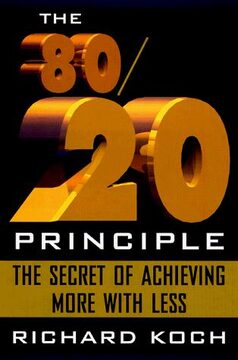
 The 80/20 Principle
Affiliate links: Sticky Idea may earn a commission, at no extra cost to you.
Koch takes the Pareto principle, the observation that a small share of causes produces most of the effects, and turns it into a way of running your work and life. A few customers bring most of the profit, a few tasks most of the results, a few relationships most of the happiness. His advice is to find that vital few, give them far more of your time, and stop treating every input as equal.
- Results are never evenly spread
- Do less, but the right things
- Apply it beyond business
Is it worth reading?Yes, if you feel busy but not effective. The core idea fits on one page, but Koch's many examples help you actually spot the vital few in your own work. Some chapters repeat the point, so skimming is fine.
The 3 big ideas from The 80/20 Principle
Results are never evenly spread
Effort and reward rarely line up one to one. When you measure, you usually find that a minority of products, clients or activities produce the bulk of the value, while the majority adds little.
Do less, but the right things
The answer to overload is not working harder but cutting the low-value 80 percent and pouring the freed time into the high-value 20 percent. Doing fewer things well beats doing everything adequately.
Apply it beyond business
The same imbalance shows up in friendships, reading, learning and happiness. Ask which few people, habits and pursuits give you most of what you care about, and protect those first.
Read the ideas free
See the ideas in real life
Put The 80/20 Principle to work
FAQ
What is the main idea of The 80/20 Principle?
That roughly 80 percent of results come from about 20 percent of causes, and that you get far more done by finding that productive minority and focusing on it. The exact ratio varies; the imbalance is what matters.
Is The 80/20 Principle worth reading?
Yes, if you feel busy but not effective. The core idea fits on one page, but Koch's many examples help you actually spot the vital few in your own work. Some chapters repeat the point, so skimming is fine.
Who should read The 80/20 Principle?
Managers, freelancers, founders and anyone with more tasks than time. It also suits students and readers who want a simple rule for deciding what to drop.
More like The 80/20 Principle
 Essentialism
 Deep Work
 Four Thousand Weeks
 The Great Mental Models
Did you find what you were looking for?
Thank you. We read every answer, and pages get fixed from what readers tell us.