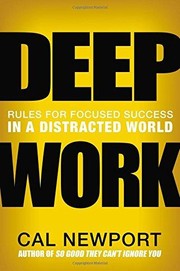
 Deep Work
Deep Work
Newport defines deep work as professional activity performed in a state of distraction-free concentration that pushes your cognitive abilities to their limit. He argues this skill is becoming both increasingly rare and increasingly valuable in a distracted, knowledge-economy world — so those who cultivate it gain an outsized edge. The second half offers concrete rules for training intense focus, embracing boredom, and draining the shallows from your schedule.
- Deep work is rare and valuable
- Shallow work crowds out the deep
- Embrace boredom to train focus
The 3 big ideas from Deep Work
Deep work is rare and valuable
The ability to focus without distraction on a demanding task is a superpower in an economy that prizes complex work. Because most people have lost it, those who keep it stand out.
Shallow work crowds out the deep
Email, meetings, and constant context-switching feel productive but rarely create lasting value. Newport urges scheduling deep blocks and ruthlessly minimizing shallow tasks.
Embrace boredom to train focus
Constantly reaching for your phone at the first hint of boredom wrecks your concentration. Deliberately tolerating boredom rebuilds the attention muscle deep work requires.
Read the ideas free
FAQ
What is the main idea of Deep Work?
That focused, distraction-free concentration is a rare and economically valuable skill, and that deliberately cultivating it — while minimizing shallow, fragmented work — leads to better, more meaningful output.
Is Deep Work worth reading?
Yes if you do knowledge work and feel scattered by digital distraction. It combines a persuasive argument with practical routines for protecting and training your attention.
Who should read Deep Work?
Students, writers, programmers, researchers, and anyone whose value comes from thinking hard about hard things. It's most useful if constant connectivity is eroding your focus.