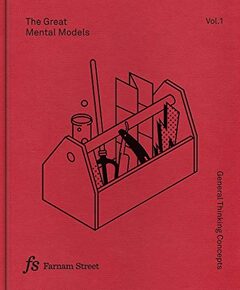
 The Great Mental Models
Affiliate links: Sticky Idea may earn a commission, at no extra cost to you.
Parrish, founder of the Farnam Street blog, collects the general thinking tools that help you understand how the world works and make fewer mistakes. Volume 1 covers core models such as the map is not the territory, circle of competence, first-principles thinking, thought experiments, second-order thinking, probabilistic thinking, inversion and Occam's and Hanlon's razors, each explained with examples.
- The map is not the territory
- Know your circle of competence
- Think a step further, and backwards
Is it worth reading?Yes, as a well-designed introduction to mental models with clear examples. If you already read Farnam Street, much will be familiar; it works best as a reference you return to.
The 3 big ideas from The Great Mental Models
The map is not the territory
Every model, plan or report simplifies reality. Useful maps help you act, but you have to remember what they leave out and update them when the ground changes.
Know your circle of competence
You make good decisions inside areas you truly understand and costly ones outside them. Being honest about where that boundary lies is a form of intelligence.
Think a step further, and backwards
Second-order thinking asks what happens after the obvious consequence. Inversion asks what would guarantee failure, so you can avoid it. Both catch errors that forward-only thinking misses.
Read the ideas free
See the ideas in real life
Put The Great Mental Models to work
FAQ
What is the main idea of The Great Mental Models?
That a small set of broadly useful thinking tools, drawn from many fields, lets you see problems more clearly and decide better than relying on a single discipline.
Is The Great Mental Models worth reading?
Yes, as a well-designed introduction to mental models with clear examples. If you already read Farnam Street, much will be familiar; it works best as a reference you return to.
Who should read The Great Mental Models?
Anyone who makes decisions under uncertainty: founders, investors, managers and students who want a practical toolkit for thinking.
More like The Great Mental Models
 Poor Charlie's Almanack
 Thinking in Bets
 The Art of Thinking Clearly
 Superforecasting
Did you find what you were looking for?
Thank you. We read every answer, and pages get fixed from what readers tell us.