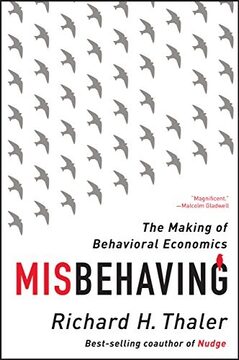
 Misbehaving
Affiliate links: Sticky Idea may earn a commission, at no extra cost to you.
Nobel laureate Richard Thaler tells the story of how behavioral economics grew from a list of odd observations into an accepted field. Through his own career, he explains the ways real people differ from the perfectly rational actors of economic models: they keep mental accounts, value what they own more than what they could buy, care about fairness and struggle with self-control.
- People keep mental accounts
- Ownership changes value
- Supposedly irrelevant factors matter
Is it worth reading?Yes, it is a witty, personal history of behavioral economics by one of its founders. It is memoir as much as idea book, so readers wanting only takeaways should pair it with Nudge.
The 3 big ideas from Misbehaving
People keep mental accounts
We treat money differently depending on where it came from and what we have labeled it for, even though a dollar is a dollar. That shapes spending and saving in predictable ways.
Ownership changes value
Once something is ours, we tend to demand more to give it up than we would pay to get it. This endowment effect makes people hold on to things and choices longer than makes sense.
Supposedly irrelevant factors matter
Framing, defaults, fairness and timing should not change rational decisions, but they do. Policies and products work better when they are designed for people as they actually behave.
Read the ideas free
See the ideas in real life
Put Misbehaving to work
FAQ
What is the main idea of Misbehaving?
That people systematically depart from the rational model of economics, and that taking these departures seriously leads to better predictions, policies and personal decisions.
Is Misbehaving worth reading?
Yes, it is a witty, personal history of behavioral economics by one of its founders. It is memoir as much as idea book, so readers wanting only takeaways should pair it with Nudge.
Who should read Misbehaving?
Readers of Nudge or Predictably Irrational who want the backstory, economics students and anyone interested in how people really handle money.
More like Misbehaving
 Nudge
 Predictably Irrational
 Thinking, Fast and Slow
 The Psychology of Money
Did you find what you were looking for?
Thank you. We read every answer, and pages get fixed from what readers tell us.