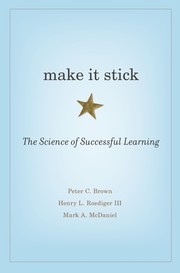
 Make It Stick
Affiliate links: Sticky Idea may earn a commission, at no extra cost to you.
Written by a storyteller and two cognitive scientists, Make It Stick explains what decades of memory research say about how people actually learn. Many popular study habits, such as rereading and highlighting, feel productive but produce little lasting memory. The methods that work feel harder: testing yourself instead of reviewing, spacing practice out over time, mixing different kinds of problems, and trying to answer before you are taught. The book argues that this effort is not a sign of failure but the very thing that makes learning durable.
- Retrieval beats rereading
- Space your practice
- Mix problems instead of blocking them
- Desirable difficulty
Is it worth reading?Yes for students, teachers, and anyone learning a skill at work. It turns memory research into specific study habits you can start using right away.
The 4 big ideas from Make It Stick
Retrieval beats rereading
Pulling information out of memory, through quizzes, flashcards, or explaining it from scratch, strengthens it far more than reading it again.
Space your practice
Leaving time between study sessions lets a little forgetting happen, and the effort of recalling it again makes the memory stronger and longer lasting.
Mix problems instead of blocking them
Practising different types of problems in one session (interleaving) feels slower but teaches you to recognise which method fits which problem.
Desirable difficulty
Learning that feels easy is often shallow. Some struggle, as long as it can be overcome, is what turns information into knowledge you can use.
Read the ideas free
See the ideas in real life
Put Make It Stick to work
FAQ
What is the main idea of Make It Stick?
That effective learning comes from effortful techniques like self-testing, spacing, and interleaving, while easy habits like rereading create an illusion of mastery.
Is Make It Stick worth reading?
Yes for students, teachers, and anyone learning a skill at work. It turns memory research into specific study habits you can start using right away.
Who wrote Make It Stick?
Peter C. Brown, a writer, with the cognitive psychologists Henry L. Roediger III and Mark A. McDaniel of Washington University in St. Louis.