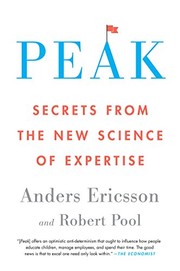
 Peak
Peak
Affiliate links: Sticky Idea may earn a commission, at no extra cost to you.
Anders Ericsson spent his career studying how experts in music, chess, sports, and medicine become exceptional. In Peak he argues that innate talent explains far less than we think, and that most extraordinary performance is built through deliberate practice: focused, structured effort on specific weaknesses, with clear goals and immediate feedback, usually guided by a teacher. Simply repeating an activity for years tends to plateau. Practice that keeps pushing just beyond your current ability is what reshapes the brain and body.
- Deliberate practice is different from repetition
- Get out of your comfort zone
- Feedback and a coach matter
- Build mental representations
Is it worth reading?Yes if you want to get better at a skill, coach others, or understand where expertise comes from. It explains the method behind the research clearly.
The 4 big ideas from Peak
Deliberate practice is different from repetition
Doing something many times does not make you better once it becomes automatic. Progress comes from targeted practice on what you cannot yet do.
Get out of your comfort zone
Improvement happens at the edge of your ability, where tasks are hard enough to stretch you but not so hard that you give up.
Feedback and a coach matter
You need fast, specific feedback to know what to correct. Good teachers design practice and spot mistakes you cannot see yourself.
Build mental representations
Experts develop detailed mental models of their field that let them see patterns, plan, and catch errors. Deliberate practice is how those models are built.
Read the ideas free
See the ideas in real life
Put Peak to work
FAQ
What is the main idea of Peak?
That expertise comes mainly from deliberate practice, focused and feedback-driven effort at the edge of your ability, rather than from innate talent.
Is Peak about the 10,000-hour rule?
Partly. Ericsson's research inspired that popular rule, but in Peak he says it oversimplifies: the kind of practice matters far more than a fixed number of hours.
Is Peak worth reading?
Yes if you want to get better at a skill, coach others, or understand where expertise comes from. It explains the method behind the research clearly.