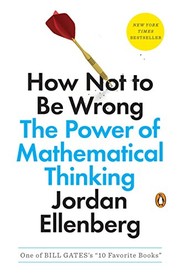
 How Not to Be Wrong
Affiliate links: Sticky Idea may earn a commission, at no extra cost to you.
Mathematician Jordan Ellenberg shows that mathematical thinking is a way of avoiding common mistakes in everyday reasoning, not a set of formulas from school. Through stories about lotteries, elections, medical studies, and wartime aircraft, he explains ideas such as linearity, regression to the mean, statistical significance, and survivorship bias in plain language. The theme throughout is that mathematics extends common sense, giving you tools to notice when a confident argument does not add up.
- Look at what is missing
- Not everything is a straight line
- Extreme results drift back
- Significant is not the same as important
Is it worth reading?Yes if you like popular science and want to think more clearly about statistics and evidence. It is witty and full of real examples.
The 4 big ideas from How Not to Be Wrong
Look at what is missing
In the story of armour for wartime planes, the bullet holes on returning aircraft showed where planes could be hit and survive. The missing data was the planes that did not return.
Not everything is a straight line
Many relationships are curved, so more of a good thing is not always better. Assuming linearity leads to wrong conclusions about taxes, health, and more.
Extreme results drift back
Unusually good or bad results are often partly luck, so they tend to be followed by more ordinary ones. This regression to the mean is easy to mistake for cause and effect.
Significant is not the same as important
A statistically significant result can be tiny or a fluke, especially when many tests are run. Ask how big the effect is and how it was found.
Read the ideas free
See the ideas in real life
Put How Not to Be Wrong to work
FAQ
What is the main idea of How Not to Be Wrong?
That mathematical thinking is extended common sense, and that a few core ideas help you spot flawed reasoning in news, science, and daily life.
Do you need to be good at maths to read it?
No. Ellenberg explains ideas with stories and keeps formulas to a minimum, though a few chapters ask for some patience.
Is How Not to Be Wrong worth reading?
Yes if you like popular science and want to think more clearly about statistics and evidence. It is witty and full of real examples.