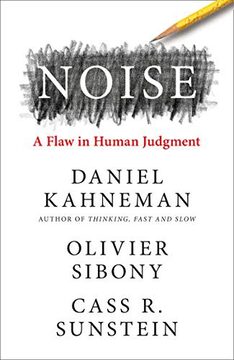
 Noise
Noise
Affiliate links: Sticky Idea may earn a commission, at no extra cost to you.
Most writing on bad judgment focuses on bias, errors that lean in one direction. This book is about noise: unwanted variability in judgments that should be the same. Two doctors, judges or insurance underwriters looking at the same case often reach very different conclusions. The authors show how large and costly that scatter is, and how decision hygiene can reduce it.
- Noise is as harmful as bias
- Measure it with a noise audit
- Use decision hygiene
Is it worth reading?Yes, if you design or make professional judgments, because noise is rarely discussed elsewhere. It is long and repetitive in places; the first parts and the decision-hygiene chapters carry the core.
The 3 big ideas from Noise
Noise is as harmful as bias
When people who should agree give widely different answers, the system is unfair and inaccurate even if nobody is biased on average. Noise is just harder to see.
Measure it with a noise audit
Give the same cases to several judges and compare their answers. Organizations are usually shocked by how far apart their experts are.
Use decision hygiene
Break judgments into independent parts, collect estimates separately before discussing them, use relative scales and simple rules. These steps cut noise without needing to know its exact cause.
FAQ
What is the main idea of Noise?
That human judgment is not only biased but also noisy, meaning inconsistent across people and occasions, and that structured decision processes can reduce this costly variability.
Is Noise worth reading?
Yes, if you design or make professional judgments, because noise is rarely discussed elsewhere. It is long and repetitive in places; the first parts and the decision-hygiene chapters carry the core.
Who should read Noise?
Managers, doctors, lawyers, hiring teams and anyone running a process where several people judge similar cases. Fans of Thinking, Fast and Slow will want it as a follow-up.
More like Noise
 Thinking, Fast and Slow
 Superforecasting
 Nudge
 The Art of Thinking Clearly
Did you find what you were looking for?
Thank you. We read every answer, and pages get fixed from what readers tell us.