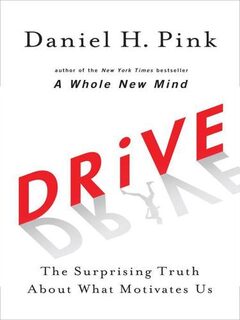
 Drive
Drive
Affiliate links: Sticky Idea may earn a commission, at no extra cost to you.
Pink argues that the carrot-and-stick approach to motivation works for simple, routine tasks but backfires on creative and complex work. Drawing on decades of behavioral research, he shows that people do their best work when they have autonomy over how they work, a chance to get better at something that matters (mastery), and a sense that the work serves a larger purpose.
- Rewards can hurt creative work
- Autonomy, mastery and purpose
- Mastery is a long, uneven climb
Is it worth reading?Yes, especially if you manage people or design incentives. It is short, clearly argued and well sourced. If you already know self-determination theory, much of it will be familiar.
The 3 big ideas from Drive
Rewards can hurt creative work
Bonuses and incentives help with mechanical tasks, but for work that needs judgment and creativity they can narrow focus and lower performance. Paying people fairly takes money off the table; tying every step to a reward does not.
Autonomy, mastery and purpose
Intrinsic motivation rests on three things: control over your task, time, technique and team; the satisfaction of steadily improving at something; and a reason for the work that goes beyond yourself.
Mastery is a long, uneven climb
Getting good at something takes effort, a growth mindset and tolerance for plateaus. People keep going when the work itself is rewarding, which is why flow and progress matter more than prizes.
Read the ideas free
See the ideas in real life
Put Drive to work
FAQ
What is the main idea of Drive?
That modern work runs best on intrinsic motivation, built from autonomy, mastery and purpose, rather than on external rewards and punishments.
Is Drive worth reading?
Yes, especially if you manage people or design incentives. It is short, clearly argued and well sourced. If you already know self-determination theory, much of it will be familiar.
Who should read Drive?
Managers, teachers, parents and anyone puzzled about why bonuses don't make them or their team more creative. It is also useful for people redesigning their own work.
More like Drive

Did you find what you were looking for?
Thank you. We read every answer, and pages get fixed from what readers tell us.